Friday, June 07, 2013

Recent Harvest

Seems like winter lasted up into may this year, then we had three months of spring happen in three weeks. Here's a few of th' fine goods we've been harvesting and eating lately. 


Milkweed shoots. Pick these before they form flowers buds, while they're still rapidly growing, and cook them anyway you'd cook asparagus. They are similar in shape and texture, but have a much better flavor, in my opinion. We like to eat them raw, but i have heard of some people getting sick from th' raw ones, nevertheless, th' flavor is much better than when cooked, so try one or two raw before you cook them, you won't get sick off of so few, and your taste buds will  be glad you did. Below are some grilled with fish, peppers and shallots. Those were good.


A few days ago we pounded and leached acorns for this mornings breakfast. 


Acorn waffles with butter and maple syrup
Then i headed into th' mountains with Alex, or Axe, as Fynn calls him to a spot we've come to call "Th' Garden". Me and Alex have an ongoing skills trade agreement, which is nice, because skill sharing is better than reading books, or laboring away solo for years. I'm learning hide tanning, among a host of other skills, and he's learning foraging, and bowmaking. Plus, it helps us all to hone our skills. It's easy to impress folks who have little experience in an area, it's something else to show off your skill to someone with experience. Helps you to always get better. Never settle for mediocre. 

We picked wild Violet flowers. 


And stinging nettle. Sorry for th' blurry picture. 


We munched dandelion flower stalks, and came to understand that stalks with flowers are more bitter than stalks with seedpods. Try it for yourself. 

One of my favorite things in th' world is walking barefoot through a mountain stream surrounded by food. We harvested a bag of raspberry leaves to dry for tea. We got rained on. And we ate Cow Parsnip. A flavor i crave every year, that tastes like no other, and cannot be bought in any store. 


We peeled and ate thistle stalks and petioles, and collected a bunch to make pickles. Thistles are very juicy, like a cucumber or a watermelon, and th' ones up here were enormous. 
Here's a thistle garden. I know you can't see how big these really are, but some of th' stalks were two inches in diameter, and full of fresh filtered water.


30 pounds of thistle in this bundle.


To eat th' flower stalks you need to peel the outer layer of fiber, or just break it in half and scrape it off with your teeth. To eat th' leaf petioles, just scrape off th' spines and eat. 


Another exciting find was th' positive identification of a new to us and very useful food, Wyeth Biscuitroot. This was a north american native peoples staple food, and another root vegetable, which is where th' calories are. 


Th' root at this time of year was fibrous and dry, but it had a good flavor. We'll be back for more in th' fall, and next spring, th' root season. Th' leaves have a flavor very much akin to fennel and dill, which we'll dry for spice. I love foraging because there is always a new plant to learn, and biscuitroot is one i've been after for a while now, and now that i know it, i'm finding it in great abundance. It's amazing how you can see a plant for years, and then one day, when you realize what it is, you see it in a brand new light. I look forward to many new experiences with this plant, and it's cousin, th' yampa. 

To finish th' day we gathered two good sized bags of Black Locust flowers. These are too good for words, but Alex says they taste like they look. Try some and see what you think. 


And, just for th' icing on th' cake, we found a four and a half foot roadkill bull snake, which we promptly skinned, and is now waiting to go on a bow's back.


All in all, it was a good day.

Tuesday, May 28, 2013

Foraging Tour and Oil Lamps


We just led our first official Foraging tour, and were pleasantly surprised at how well it went. We had about twenty folks there, and planned th' tour for two hours. But as always with foraging, there's no end of surprises. 

There were lots of kids, and they found a nice little hobo shelter to play in while we talked about th' yellow dock plant, and learned how to twist dogbane into a nice string, which me and Josh used for oil lamp wicks.


Rosemary with a nicely twisted string

th' kids in their hobo shelter

Friday, May 10, 2013

Stalking th' wild Asparagus, and other spring goodies

I awake- have a cup of coffee and read the asparagus chapter from Euell Gibbbon's Stalking the Wild Asparagus. That's my goal today. Asparagus.

Spring greens are growing like weeds around here. Oh wait, they are weeds. Anyway, started off th' harvesting with some Salsify plants, also known as Oyster roots.


Oyster roots
  At first glance Salsify looks a lot like th' grass it grows amongst. You gotta put on your "Salsify Eyes", and then they stand out from th' crowd.
You can eat  this whole plant, th' tops tasting like a sweet, almost creamy green,
a good addition to a salad. But th' cream of th' crop here is th' root, which when roasted or baked becomes an incredible delicacy that can't be bought from a store. We wrote a previous post on these, and how to find them amongst th' grass in which they grow, and that they hide very well amongst.

From there it was on to the asparagus. It was just beginning to sprout, mostly what i harvested was tips, but oh were they good tips. In th' words of a first time asparagus forager who accompanied me, "it tastes like,,,,th' way food should taste." 


Like th' Salsify, you gotta put on your "Asparagus Eyes" when huntin these guys. 
Asparagus spreads by rhizomes, so Look for last years stalks, and check th' ground around them. Below is a picture of an old Asparagus stalk, on th' right, and a yet to be identified plant whose stalk looks kinda similar, and usually grows in th' same location. With a little experience, these old stalks look unique, and can be told apart even from a vehicle moving thirty miles an hour down th' road.


 Below are some blanched spears, or spears that've grown under debris, making them white, and tender, more so than th' green ones poking up into th' sun.


Also on the agenda, i got us a good Curly Dock harvest. 


This is a hearty green, which makes a mean saag paneer, and goes really well in lasagne, or enchiladas. And it's one of our most easily identifiable wild foods. Just look for last years rust colored seed stalks. 

And some bitter lettuce, or compass plant. These truly are bitter, but still make a good cooked vegetable, and if you've built up your bitter palate, in this stage they are quite good. It's called compass plant because when it gets older all of it's leaves turn and face th' same direction, ie, that of th' sun. 


And there's always something unexpected waiting to be found. Like a toy boat sailing amidst a patch of Watercress.


And still, after almost a month, thanks to our late season coldness and excessive snow/rain, we're harvesting th' purple "Musk" Mustard. 


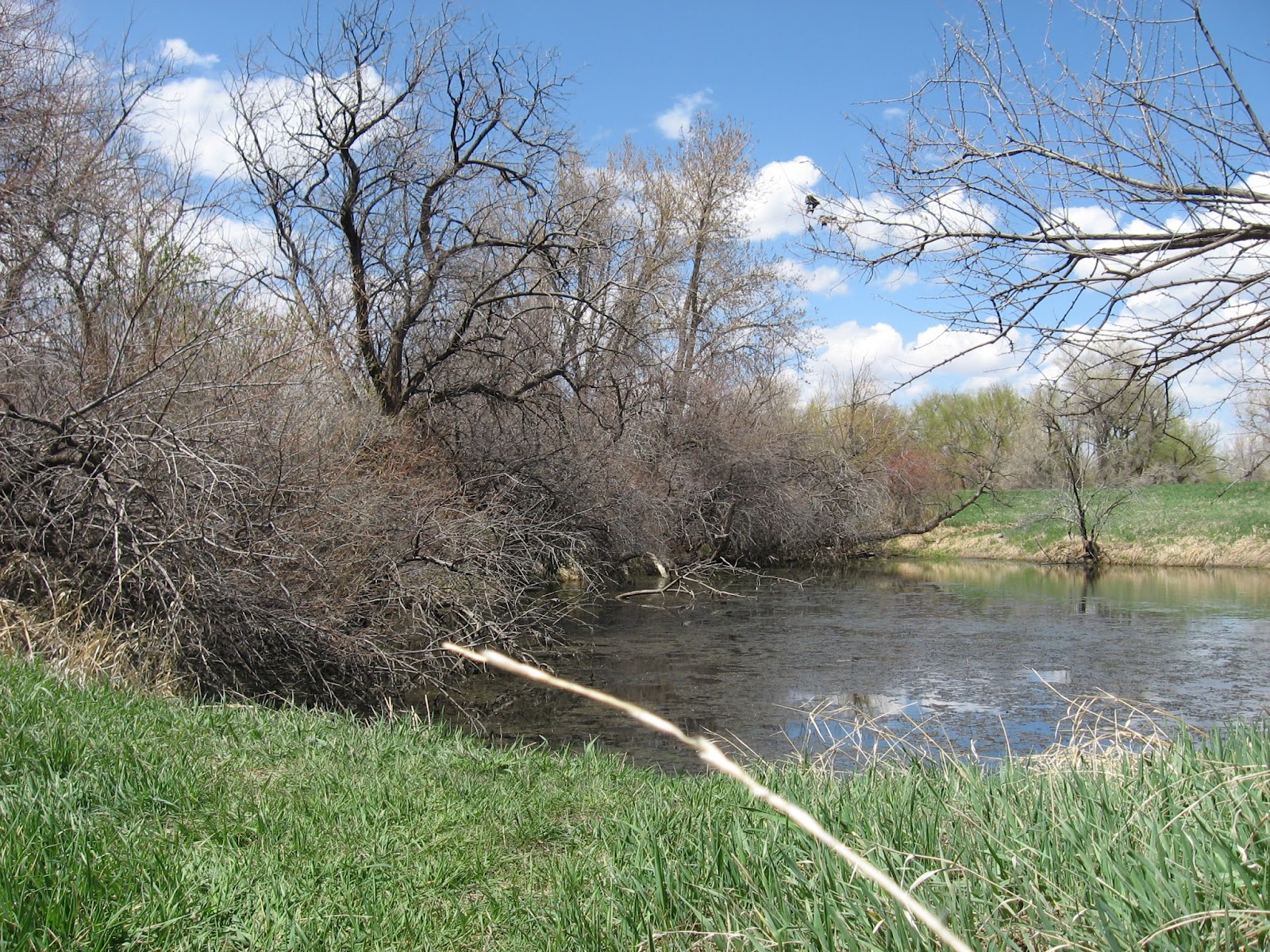
I love my job. Being a professional forager definitely isn't going to make anyone rich, monetarily. But when i find a diversity of vegetables greater than i can buy in th' supermarkets, and th' only price i have to pay is being outside gathering them, observing th' world i love, sometimes with th' people i love, getting hot, getting rained on, getting wet, drying off, seeing a fawn and it's mother grazing in a field, watching th' clouds dance above,  i find it an acceptable price to pay. Especially when th' view from my "office" looks like this.


Or when i'm gazing upon Ft. Collins' hidden canyon.


In th' words of Madeleine L'Engle, "Being alive is a marvelous, precarious mystery, and few people appreciate it."

~Rico