Ok friends, we've decided to merge our foraging and crafts blogs into
one, which will be this one. After all, it's all traditonal, old world
activity, so why th' dichotomy? If you're unfamiliar with our crafts
blog i'll just tell you that all th' work i do is done without power
tools, i don't even own any. I don't say this to brag but to clarify
that it's more about th' process than the end result, more about that
later...Now we can do posts like this one...
 |
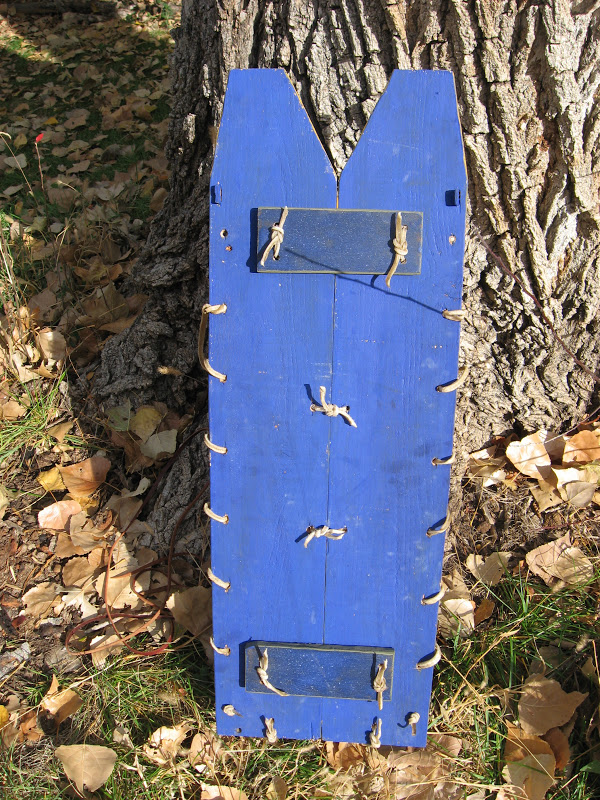
| spoon rack |
This past week has been rife with
activity- Acorn processing and wood carving and turning to name a few.
The above picture is a spoon rack i carved from a split elm sapling.
Wooden spoons are beautiful on their own, but displayed in a nice rack
they are outstanding, why hide them in a drawer? All th' spoons were
carved by me except th' two in th' middle with th' white and blue
handles, which were carved by
Jarrod Stonedahl, another journeyman of traditional living.
But lets talk about fall, and food gathering for a bit... anyone for some acorns?
 |
| burr oak acorns, big. |
Anyone in Fort Collins reading this blog? If so, you
wanna do me, or yourself rather, a favor and go out gather up some oak
nuts? We're really running out of room to store them, and it's hard for
me to pass them by. There's still a lot out there. I'll even help you
eat them if you want. But seriously, my neighbors are starting to think
that
Ishi
lives in my garage... help us out why don'tcha. Just look at this tree,
it's covered with large acorns, half an hours worth of picking supplied
us with over ten pounds. And there's a lot of half-hours in a persons
life.
And don't think this is unusual around here, there's trees all over like this. You'll see.
Let's get crackin shall we...
Look at th' inside of th' shell, how beautiful it is...
Here's a Burr Oak acorn on th' left, and an average size, unidentified as of now, acorn on th' right.
Th'
Burr Oak acorns are enormous, so be carefull while drying them out, as
they take a very long time. Sometimes you'll come across ones with
sunken in centers like in th' picture below.
Don't waste your time gathering these, as this is what you'll find inside.

We
crack and pound all our acorns by hand. I've used blenders and coffee
grinders before, but they don't work as well as pounding with a
hammerstone. And more importantly, they don't work th' same way on me.
And this is also why i don't use power tools, th' real reason. When i'm
pounding acorns, in th' sun, with a rock, it does something to me. It
takes a long time, but it's time well spent. My mind is fee to wander,
while my hands perform th' task at hand. I smell the acorn, i breathe it
in along with th' scent of dry leaves. (Do you know how good pounded
acorns smell?) If affects me in a subtle, yet powerful way. It's th'
same with carving wood with hand tools. Th' time spent changes you,
makes you, builds you into a more patient, more thoughtful person. The
end result becomes less important than th' way you get there. Th' native
americans, and traditional people all over th' world, spent thousands
of years pounding acorns with rocks, who are we to say we've come up
with a better way. Have we really counted th' cost of what we've given
up? Have we counted th' cost of th' tools that we now depend upon, that
we consider necessary for life? It's hard, because we are so
disconnected from th' price we pay, to even realize that a toll is being
extracted. We don't remember what it's like to be able to drink water
from our rivers and streams, or that there used to be mountains in
Wyoming and West Virginia that no longer exist due to coal mining. Or
that there were no landfills here a few hundred years ago. Me cracking
acorns with a rock, or hewing out a piece of wood with an axe isn't
going to change all that, but me and you doing it, and you, and you too,
well then, things might start to look different. Or at least we'll be
different, and that's worth it.
 |
| acorn pounding |
Here's Beth and Fynn partaking of some fall activities, as i was hewing some bowl blanks one day.
 |
| axe hewn bowl blank |
This is black locust
wood, which has a relatively easy to work yellow sapwood and a
seriously hard and pretty brown heartwood. It makes really pretty bowls
and bows.
 |
| pole lathe turned bowls |
Before I made these
two i was really turning in th' dark. I was so focused on getting a bowl
that i didn't pay enough attention to how i got one. Then i was forced
to spend two weeks away from my shop. I got craftsmans withdrawal. But
something happened. I learned (again) to slow down. When i got back home
i took my time, went slower, focused more on making nice clean cuts and
keeping my tools sharp. I slowed down and my bowls and spoons came out
better and in half th' time or less. Here's th' rest of what came of
that locust log, as well as a couple of Aspen spoons.
This one got cold, so i had to carve a hat for it.
Here's
a couple made from opposite sides of th' log, th' one on th' left has
th' sapwood on th' bottom, heartwood on top, and th' one on th' right
has th' heartwood on th' bottom, making a different, and in my opinion
nicer looking bowl, though it takes longer to hew because of th' greater
amount of heartwood you're chopping. These are fresh off th' lathe,
where as th' darker ones have been oiled already.
Here's
that bow i was carving in th' last post, it's almost finished, and
pulling about eighty pounds right now. Just needs to be CAREFULLY
tillered down to about fifty-five, and it's ready for th' hunt.
 |
| Ash bow, ancient European style |
And two Aspen spoons.
Well,
i hope you've had some good food for thought, even if you can't eat the
acorns. Drop us a line and let us know what you think. I'll leave you
with a few more scenes of fall.
Cheers
~Rico
 |
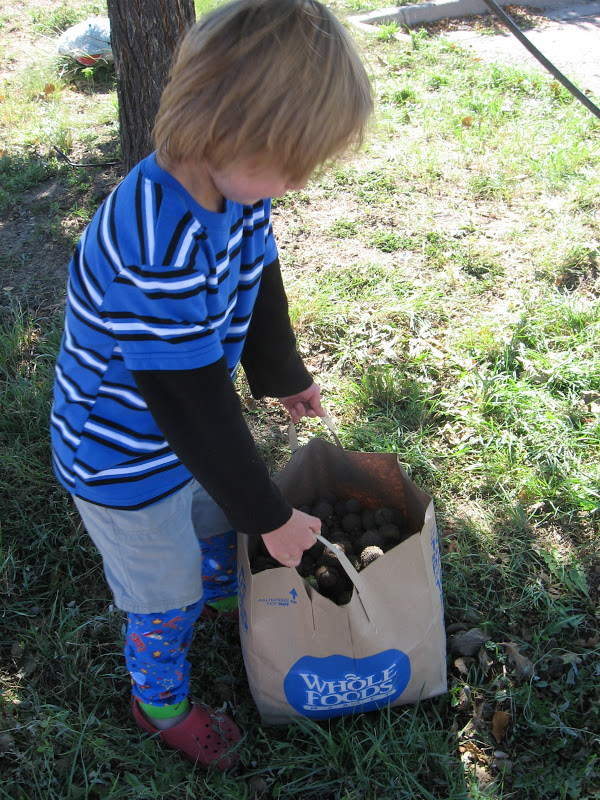
| Bag full of acorns. Now that's some whole foods. |